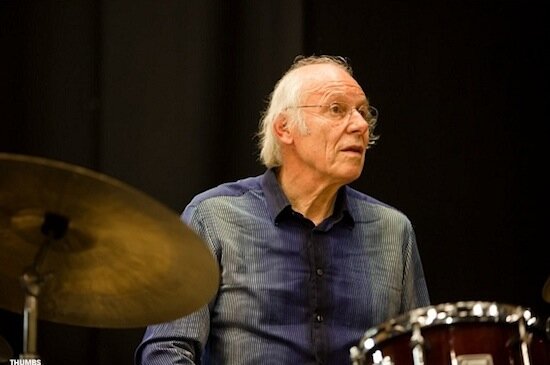
Tony Levin 1940-2011


Tony Levin at mac, Birmingham, 9 October 2010 (Photo by Russ Escritt).

We are hugely saddened to report the death of drummer Tony Levin, who passed away today at the age of 71. Tony was a highly regarded jazz drummer and one of our partners on the AHRC KTF project. Together we developed http://tonylevin.org and produced academic research into building British jazz archives.

Tony was highly respected for his performances on several great British jazz albums and performed frequently at Ronnie Scott’s Jazz Club in the 1960s with artists including Joe Harriott, Al Cohn, Harry “Sweets” Edison, Zoot Sims, and Toots Thielemanns.

Continue reading

Digital Academic Publishing event report

Representatives of Sage, Palgrave, Berg, Humanities eBooks, Intellect, Adam Matthew Digital, JURN and several University publishing houses joined academics from the Birmingham Centre for Media and Culture Research on Monday 6th September at a conference to discuss the field of Digital Academic Publishing.

The Keynote speech by Masoud Yazdani of Intellect Books is available on the audio player below.

Masoud Yazdani- Digital Academic Publishing by Interactive Cultures

Continue reading

Digital Academic Publishing – researching the field

Editors and publishers conference

Monday 6th September 2010

Digital development and Application; Content and Creativity

The publishing industry is currently undergoing major challenges: digitisation: is changing the material form of the industry’s key artefacts; the internet is transforming the potential ways in which publications can be distributed and the expectations of their consumers; and these two lead to profound implications for the business models of companies in the industry. Through this event we hope to bring together individuals and organisations involved in academic publishing to identify the issues and set out a way forward. We will present research we have undertaken into the perceptions of publishers, and identity models for the future which have been developed in both publication and our own work with the music business.

Continue reading

Fight the Power: The Art of Protest and the Theory of Social Objects


The question isn’t “what is this picture about?” or even “what does it mean to you?” – but “given this picture, what shall we talk about?”

I’ve been working recently with Punch Records in Birmingham in a Knowledge Transfer capacity, to explore some theories about online and social media, and apply them to their music and arts activities.

I’m interested in the ways in which people use media online as “social objects” – that is, to take those objects and use them as the occasion for online conversation. And in doing so, people seem to make sense of those objects (whether they’re images, video or music) and recontextualise them in the service of whatever stories or conversations they’re trying to communicate.

One of the interesting things that Punch has been focused on recently, and launched last night at the Custard Factory here in BIrmingham, is an exhibition called Fight The Power, which presents images and posters of protest and propaganda. And one of the interesting things about the exhibition is that it’s designed to be experiential, rather than simply a display that you can quietly and passively consume.

Continue reading

The Cine-Excess of Dario Argento’s Suspiria

Our Wednesday research seminar this week was a presentation by Xavier Mendik of Brunel University. Xavier introduced a screening of the documentary Fear at 400 Degrees: The Cine-Excess of Dario Argento’s Suspiria.

Xavier was invited to our regular research seminar to talk about the strategies he has developed for knowledge transfer work around the Cult Film Archive and Cine-Excess, the company he has formed to restore and reissue significant cult films. The release includes DVD extras that are designed as educational and knowledge transfer devices. The formula is working well with interest in the film and its academic based extras leading to significant interest from relevant media and sales reaching audiences beyond the academy.

Dario Argento’s Suspiria (1977) classic cult Italian horror – a masterpiece of the modern macabre that uses excessive visual styles and even more excessive on-screen murders to create new pathways between art-house and atrocity. The documentary featured enough footage from the original to cause one member of the audience to “step outside for a breath of fresh air”.

Research group member, and chair of this week’s session, Oliver Carter commented: “I have followed Xavier’s work closely since the late 1990s and it was a pleasure to welcome him to this week’s session.  Xavier’s work with Nouveaux Pictures and the Cine Excess label  demonstrates the variety of possibilities knowledge transfer presents.  We are thankful for him taking time to come to the Birmingham School of Media and look forward to sharing our approaches to knowledge with him in the future.”

What does the future look like?

Digital Innovation Lab (job opportunity)

We don’t know what the future of digital marketing looks like, nobody does, really. You might say it’s all about touch or augmented reality but that’s already happening. What happens next? One of our latest projects will aim to find out by shaping the next big thing.

Over the next two years we will be working with leading marketing agency Clusta, to develop a digital innovation lab within their business. Breaking media firsts is a key part of what Clusta do; this project gives us and the agency a chance to build on these foundations and explore how we can make innovation processes the heart of a creative business.

Can you help shape the future of digital marketing?

The project is being realised through the Knowledge Transfer Partnerships scheme. We are currently recruiting an associate to work with Interactive Cultures and Clusta in developing the lab. The associate will be a recent graduate (or will be about to graduate) who will work day to day within Clusta establishing the lab, and eventually leading a small team of digital innovators, matching new uses of technology to client briefs. The associate will be supported by staff in the Interactive Cultures unit and User Lab at Birmingham Institute of Art & Design.

We are developing a number of KTP projects. If you would like to talk to us about how we could work with your business, through KTP or other approaches, please contact Annette Copper on 0121 331 7280 or email annette.copper@bcu.ac.uk.